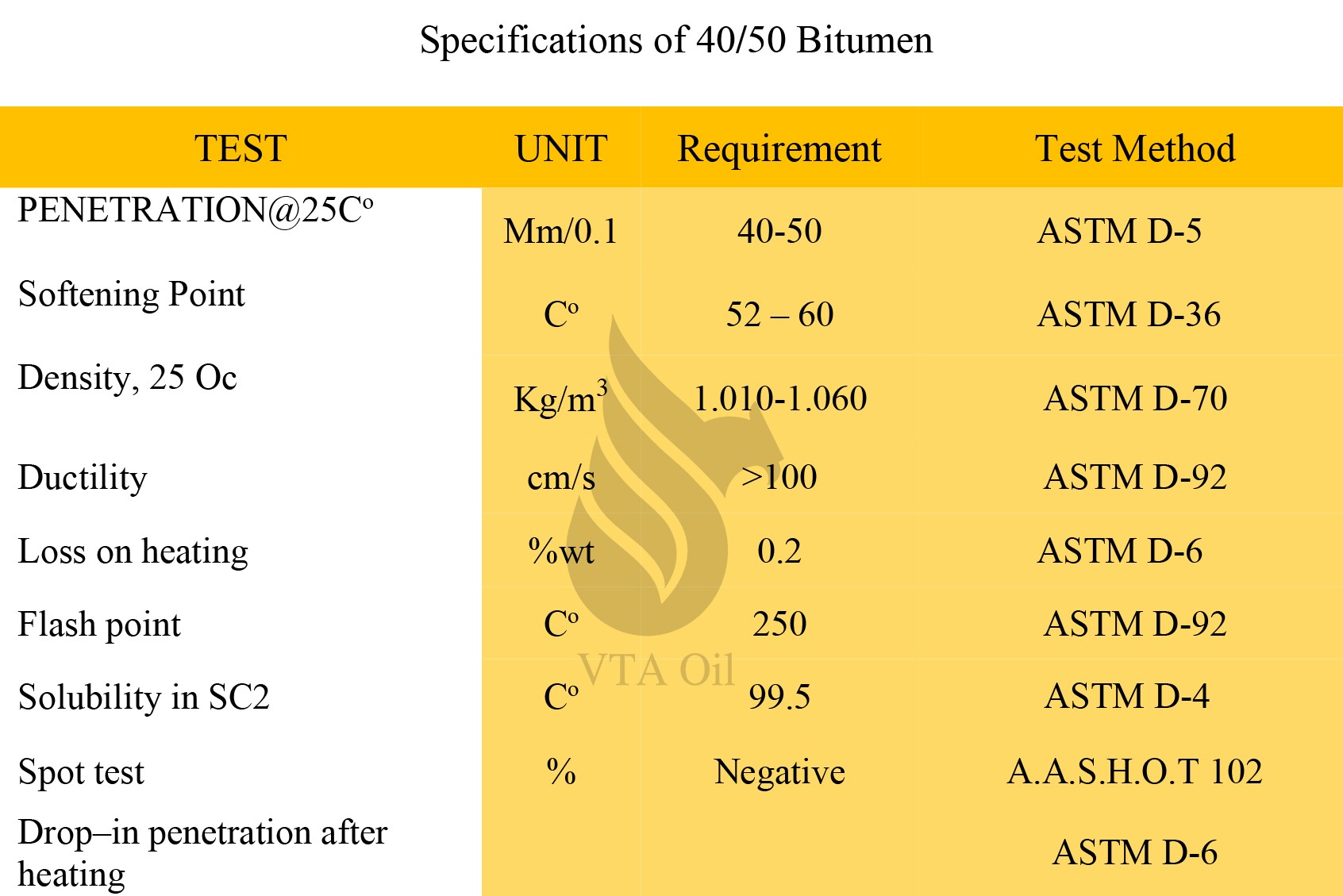
Bitumen Penetration Grade 40/50
VTA OIL CO. specializes in the supply and distribution of petroleum and petrochemical products
Bitumen grade 40/50, also known as penetration grade bitumen, is a type of bitumen commonly used in road construction and other industrial applications. Here are some key characteristics:
Penetration: The penetration value at 25°C is between 40 and 50 mm/10, indicating the hardness of the bitumen.
Softening Point: The softening point ranges from 52°C to 60°C, which shows the temperature at which the bitumen becomes soft.
Ductility: At 25°C, the ductility is a minimum of 100 cm, reflecting the bitumen’s ability to stretch without breaking.
Specific Gravity: The specific gravity at 25°C is between 1.01 and 1.06 g/cm.
Flash Point: The flash point is a minimum of 250°C, indicating the temperature at which the bitumen can vaporize to form an ignitable mixture in air.
Solubility: The solubility in carbon disulfide (CS2) is a minimum of 99.5%, showing the purity of the bitumen.
These properties make bitumen grade 40/50 suitable for use in environments where a balance of hardness and flexibility is required, such as in the construction of highways and other paved surfaces.
Bitumen grade 40/50 has several important applications, primarily in the construction and maintenance of roads and pavements. Here are some key uses:
Road Construction: It is widely used as a binder in asphalt concrete for constructing highways, streets, and other paved surfaces. Its balance of hardness and flexibility makes it ideal for withstanding traffic loads and environmental conditions.
Pavement Maintenance: Bitumen 40/50 is also used in repairing and maintaining existing pavements. It helps in filling cracks and potholes, ensuring a smooth and durable surface.
Waterproofing: Due to its excellent waterproofing properties, it is used in roofing and damp-proofing applications. It helps in preventing water penetration and protecting structures from moisture damage.
Industrial Uses: Bitumen 40/50 is used in various industrial applications, such as in the production of bituminous paints, coatings, and adhesives.
These applications leverage the material’s durability, adhesive properties, and resistance to water and weathering, making it a versatile choice in construction and industrial sectors.